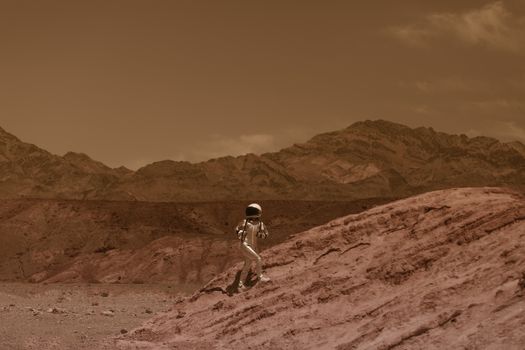
What if you could explore a Martian landscape that looks like a giant honeycomb?
Nasa’s Curiosity rover has just made a groundbreaking discovery that’s turning heads and sparking imaginations. In a stunning new find, Curiosity has uncovered a vast field of polygonal shapes in a Martian valley known as Valle Grande.
A Pattern Like No Other
These intriguing formations, resembling a sea of interconnected polygons, have been spotted before, but this is something else entirely. Each polygon measures about 1.5 to 3 inches wide, and previously, scientists only found these features in small patches. Now, Curiosity has revealed them on a massive scale, stretching out in a mesmerizing pattern.
The Rover’s Stunning Panorama
On June 19th and 20th, during Martian sols 4,930 and 4,931, Curiosity captured a breathtaking 360-degree panorama of this “sea of polygons.” The images showcase the unique terrain as it spreads infinitely, leaving scientists and space enthusiasts alike in awe. Project scientist Ashwin Vasavada expressed the excitement of the team, noting, “We’re seeing something completely different than we expected!”
Why This Matters
This discovery is not just a visual feast; it holds significant implications for understanding the geological history of Mars. The honeycomb-like structures suggest that the Martian surface has undergone processes that we are only beginning to comprehend. This could provide clues about past water activity on the planet and its potential for habitability.
What Happens Next?
So, what’s next for the Curiosity rover? The team plans to analyze the compositions of these polygonal features in more detail. By sending more data back to Earth, scientists hope to decode the mysteries of Mars’ ancient climate and geological processes.
As we continue to explore our neighboring planet, discoveries like this remind us just how much we still have to learn. This “sea of polygons” is just one piece of the puzzle, and who knows what else is waiting to be uncovered?
Stay tuned as Curiosity digs deeper into the Martian surface. The excitement is far from over!
Source: Read original article